
Table of Contents
- What Makes a Dog Bed Chew-Proof
- Chew-Proof Dog Bed Materials That Hold Up
- Heavy Duty Dog Bed Covers and Maintenance
- How to Choose the Right Size and Support
- How to Stop a Dog From Chewing Their Bed
- Safety, Warranties, and Repairability
- Frequently Asked Questions
Last Updated: September 16, 2026
What Makes a Dog Bed Chew-Proof
Dog beds for chewers use reinforced stitching, puncture-resistant fabrics, and a frame or cover design that resists tearing under sustained biting. Construction quality, not marketing claims, separates a bed that survives a determined chewer from one that ends up as stuffing on your floor. Most beds marketed as "durable" use single-stitched seams and thin fabric a strong jaw can breach in minutes.
Destruction Testing: How to Judge Durability Before You Buy
With no standardized third-party test for pet bed durability, buyers must evaluate construction themselves. Inspect three stress points: seams, zippers, and corners. Triple-stitched seams with ripstop nylon resist pulling apart far better than single-stitched alternatives, metal zippers outlast plastic, and reinforced corners, where dogs bite first, should show double-layered fabric.
| Feature to Check | Weak Sign | Strong Sign |
|---|---|---|
| Seam construction | Single-stitched | Triple-stitched |
| Fabric type | Generic "soft fabric" | Ripstop nylon, heavy canvas |
| Corners | Standard hem | Reinforced, double-layered |
| Zipper | Plastic teeth | Heavy-duty metal |
| Warranty | None stated | Chew-proof guarantee offered |
Chew-Proof Dog Bed Materials That Hold Up
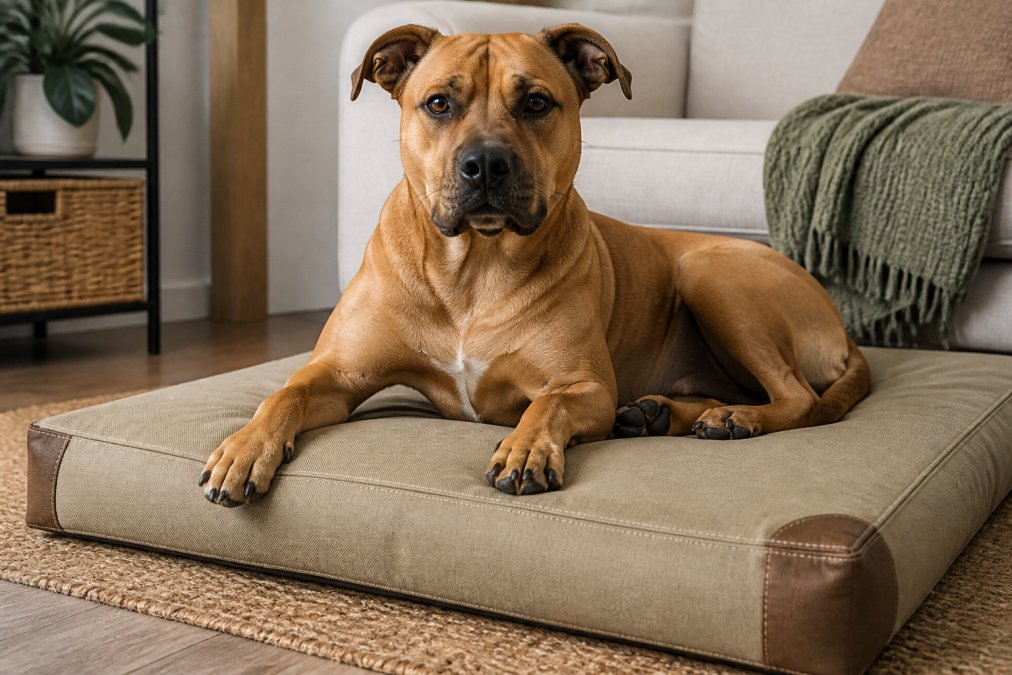
The most durable dog beds for chewers rely on proven materials: ripstop nylon, heavy-duty canvas, and reinforced ballistic-style fabrics, whose weave resists tearing even after a puncture starts. Higher denier means thicker, stronger thread, so a 1,000-denier fabric outperforms a 600-denier fabric against the same dog.
What Actually Makes Each Material Tough
Ripstop nylon. A reinforcement grid woven into the fabric at regular intervals stops a tear from running across the whole cover, the same principle used in parachutes and camping tents. For a chewer, a small puncture stays small instead of becoming a shredded panel. Ripstop is lighter than canvas, making it a good fit for elevated beds where the cover must stay taut.
Denier, Thread Count, and Why Both Matter
Denier measures yarn weight per 9,000 meters: a higher number means thicker, heavier thread, generally stronger, but not automatically more chew-resistant if the weave is loose. Thread count (picks per inch) tells you how tightly threads are packed, and a high-denier fabric with a loose weave can still be pulled apart at the seams. If a description lists only one number, be cautious.
Coatings and Treatments to Look For, and to Avoid
Waterproof and stain-resistant coatings can extend a bed's life, but not all are equal. Polyurethane (PU) and thermoplastic polyurethane (TPU) coatings on washable covers hold up better than older PVC-based coatings, which crack and flake with flexing. Look for water-based or phthalate-free coatings if your dog mouths the surface.
Matching Material to Chewing Style
Not every chewer attacks the same way, and the material that survives one style may fail against another:
- Edge and corner chewers target seams and hems. Reinforced, double-layered corners and triple-stitched seams matter more than the base fabric.
- Surface gnawers work on flat panels. High-denier ripstop or ballistic nylon resists puncture best here.
- Diggers and scratchers abrade fabric with their claws. Tight-weave canvas and scratch-resistant outer shells hold up longer than loose knits.
- Stuffing pullers exploit any breach. A firmer, denser fill (memory foam or high-density shredded foam) gives them less loose material to grab if the cover is compromised.
Elevated vs. Floor-Style Beds for Aggressive Chewers
Floor-style beds work better for dogs that chew from anxiety, since the enclosed feeling can be calming. Match the style to why your dog chews, not just how hard they bite.
Heavy Duty Dog Bed Covers and Maintenance
Heavy duty dog bed covers extend bed longevity more than any other single purchase decision. A removable, machine washable cover lets you clean accidents, drool, and odor without replacing the whole bed. Look for heavy-duty zippers and waterproof liners, since trapped moisture causes odor and material breakdown.
- Machine washable covers reduce replacement frequency
- Waterproof liners prevent odor and mildew
- Heavy-duty zippers survive repeated removal
- Scratch-resistant outer fabric resists claw damage
How to Choose the Right Size and Support
Size and orthopedic support affect how long a bed lasts and how well your dog uses it. A bed that's too small forces your dog to bunch up, stressing seams; one that's too large invites chewing at loose edges. Measure your dog nose to tail while stretched out, then add a few inches of clearance per side.
Sizing by Measurement, Not by Weight
Weight charts are a rough starting point but ignore body shape, a long-backed dog and a stocky dog of the same weight need very different dimensions. Measure three things:
- Nose-to-tail length while your dog is fully stretched out, this sets the minimum interior length.
- Shoulder width, the bed should be at least 1.5 times this so your dog can turn around without pressing into the bolsters.
- Preferred sleeping posture, a curler needs a bed roughly the length of its body plus a few inches; a sprawler needs the full stretched length plus clearance.
Fill Types and How They Affect Chew Resistance
Orthopedic support matters most for older dogs or large breeds prone to joint issues. But fill choice also changes how a bed behaves under a chewer:
- Solid memory foam. Holds its shape longest, supports joints, and offers the least loose material if the cover is breached. It's the most expensive option and heavy to move.
- High-density shredded foam. A middle ground, supportive, lighter than solid foam, and less messy than fiberfill if punctured. Quality varies; cheap shredded foam flattens within months.
- Fiberfill (polyester batting). The cheapest and softest option, but it clumps, flattens, and produces clouds of loose stuffing the moment a cover tears. For a determined chewer, fiberfill is the worst-case fill.
- Orthopedic egg-crate or convoluted foam. Provides pressure relief but is thinner and less durable than solid memory foam. Often used as a topper over a firmer base.
Repairability: Extending the Life of a Bed You Already Own
Most high-end beds fail at one of three points: a seam, a zipper, or a corner. All three can often be repaired rather than replaced, far cheaper than buying a new bed yearly.
- Seam repairs. A triple-stitched seam that's pulled apart can usually be re-stitched with heavy-duty upholstery thread and a curved needle. Reinforce the repair with a patch of ripstop nylon on the inside.
- Zipper repairs. If the zipper teeth are intact but the slider has failed, replacing just the slider is a common fix. If the teeth are damaged, a tailor or upholsterer can replace the entire zipper for a fraction of a new bed's cost.
- Corner patches. Corners take the most abuse. An iron-on or sew-on patch of heavy canvas or ballistic nylon over a chewed corner can add months or years of service.
- Cover replacement. Beds with removable covers let you replace the most common failure point without buying a new frame or fill. When comparing beds, check whether replacement covers are sold separately, that single detail often determines whether a bed lasts two years or five.
Warranty and Replacement Policy as a Sizing Decision
Warranty coverage and replacement policy separate confident manufacturers from the rest. A chew-proof guarantee signals the maker stands behind the construction. Read the fine print: some warranties exclude chewing damage entirely, while others cover it only for a limited period or require proof of purchase and photos.
American Kennel Club guidance on destructive chewing
How to Stop a Dog From Chewing Their Bed
- Boredom: more exercise and puzzle toys
- Teething: appropriate chew toys, frozen treats
- Separation anxiety: gradual crate training, calming routines
- Stress or routine changes: consistency and patience
- Simple curiosity: redirection to approved chew items
A dog that chews from separation anxiety needs a different plan than one that chews from boredom. Watch when the chewing happens. If it's only when you leave, anxiety is likely the driver. If it's random throughout the day, boredom or teething is more probable.
Safety, Warranties, and Repairability
Safety comes first with aggressive chewers. Any bed that's been breached, with exposed stuffing or loose fabric, becomes a choking and obstruction hazard, remove it immediately rather than patching it temporarily. Check for non-toxic material claims and avoid beds with small detachable parts.
American Kennel Club guidance on destructive chewing
Frequently Asked Questions
What are the best chew-proof pet beds for dogs?
The best dog beds for chewers use heavy-duty fabric like ripstop nylon or ballistic canvas with triple-stitched seams and reinforced corners. Look for beds with a waterproof liner, a heavy-duty zipper, and a chew-proof guarantee. Elevated frame-based beds work well because there is less loose fabric to grab. Always match the bed to your dog's size and chewing style, and check the warranty before buying.
What is the toughest material for dog beds?
Ballistic nylon and ripstop nylon are among the toughest options, especially in higher denier weights. These fabrics resist punctures and tears because the weave stops rips from spreading. Triple-stitched seams and reinforced corners add strength at the stress points where dogs bite and dig. Canvas is also durable but softer and easier to puncture, so it suits mild chewers better than aggressive ones.
Can a dog bed be both comfortable and chew-proof?
Yes. Many durable beds pair a tough outer shell with orthopedic support inside, such as memory foam or a thick padded base. The chew-resistant cover protects the cushion, while the foam gives joint support for older or larger dogs. Choose a bed with a removable, machine washable cover so you can keep it clean without replacing the whole bed. Comfort and durability work together when the materials are chosen well.
How do I stop my dog from chewing their bed?
Start by addressing the root cause. Chewing often comes from boredom, excess energy, or separation anxiety. Give your dog more exercise and appropriate chew toys, and rotate them to keep interest high. Place the bed in a spot where your dog feels secure. If anxiety is the trigger, talk to your vet about calming options. A chew-proof bed buys you time, but training and enrichment solve the behavior long term.
Destructive chewing is frustrating, but it doesn't have to mean replacing beds every few months. Pet and Home Outlet stocks durable beds built with reinforced corners, machine washable covers, and heavy-duty materials designed to hold up to aggressive chewers. With better prices on quality products and a range of sizes and styles, you can find a bed that fits your dog and your home. Check out Pet and Home Outlet to find durable dog beds for chewers and stop the cycle of constant replacement.