
Table of Contents
- Quick Comparison: What Matters Most in Durable Cat Trees for Large Cats
- Solid Wood vs. Particle Board: Why Construction Decides Durability
- Cat Tree Weight Capacity: What Heavy and Multi-Cat Households Need
- Cat Tree Stability Tips for Wobble-Free Climbing
- How to Secure a Cat Tree to the Wall (Step by Step)
- Oversized Perches, Reinforced Posts, and Space-Saving Designs
- Replacement Parts, Assembly, and Long-Term Care
- Conclusion
- Frequently Asked Questions
Last Updated: September 17, 2026
Quick Comparison: What Matters Most in Durable Cat Trees for Large Cats
Durable cat trees for a large cat need a wide weighted base, solid wood or thick plywood framing, and reinforced posts that resist wobble under repeated jumping. Weight capacity, not height, is the deciding specification. This guide from Pet and Home Outlet breaks down construction, stability, and safety so you can choose once and stop replacing furniture every year.
| What Matters | Why It Decides Durability | What to Look For |
|---|---|---|
| Base footprint | Prevents tipping under jump force | Wider than the top platform by a clear margin |
| Frame material | Determines lifespan and screw holding | Solid wood or thick plywood |
| Post reinforcement | Stops flex at the joints | Internal threaded rod or bolted brackets |
| Weight capacity | Sets safe cat count and size | Rated for your heaviest cat plus margin |
| Anchoring hardware | Removes residual wobble | Wall strap or bracket included |
Solid Wood vs. Particle Board: Why Construction Decides Durability
Solid wood and thick plywood hold screws and resist moisture far better than particle board, which crumbles once a bolt loosens and re-tightens. The frame is the biggest predictor of how long a cat tree lasts.
Cat Tree Weight Capacity: What Heavy and Multi-Cat Households Need
Cat tree weight capacity should exceed your heaviest cat's weight with a healthy margin, and multi-cat households need capacity rated per platform, not just for the whole unit. A tree rated for one twenty-pound cat is not automatically safe for three average cats.
A Standardized Weight-Capacity Rubric
Score each tree on the four tests below. A tree that passes all four is genuinely rated for a large cat; one that fails any test is a kitten tree wearing large-cat packaging.
- Static load test. Place a dumbbell, bag of cat litter, or stack of books equal to your heaviest cat's weight plus 50 percent on the highest platform. After 24 hours, measure the drop. More than about a quarter inch signals the post-to-platform joint is compressing, where failures start.
- Dynamic load test. With the static weight in place, press down firmly and release five times to simulate a landing. Listen for creaks and watch for base lift-off at any corner, a lifting corner means the footprint is too small, whatever the spec sheet says.
- Lateral sway test. Grip the top post and push it side to side with moderate force. More than roughly an inch of travel at the top, with the base planted, means the post core is flexing rather than the base tipping, a more dangerous failure because it happens gradually.
- Fastener retention test. After the static load test, re-tighten every bolt and note how much each turns. Bolts that turn more than a quarter rotation after 24 hours under load are backing out and need thread-locking compound or scheduled re-tightening.
Turning the Rubric Into a Load Number
Convert pass/fail results to a working capacity:
- Per-platform capacity = the static load held without measurable drop, divided by 1.5 for a jump-force safety margin.
- Whole-unit capacity = the sum of per-platform capacities, capped by base footprint. As a rule of thumb, a base needs roughly one square foot of footprint per 15 pounds of total rated load to stay planted under dynamic force.
- Multi-cat derating = subtract 20 percent from whole-unit capacity for every additional cat sharing the tree, since cats land on the same platform from different angles and concentrate stress on one joint.
A worked example: three platforms holding 30 pounds static each give a per-platform working capacity of 20 pounds. That is 60 pounds whole-unit, but a two-square-foot base caps the realistic total at about 30 pounds, enough for one large cat plus one average cat, not three large cats.
Why the Failure Mode Matters
Post-to-platform bolts fail suddenly, when a cat is mid-jump at peak force. That is why the margin matters more than the headline number: a tree that creaks under a static test will not warn you before it lets go under a landing.
Cat Tree Stability Tips for Wobble-Free Climbing
Stability comes from three things working together: a heavy base, a low center of gravity, and a physical wall anchor. Remove any one and a large cat will eventually rock the tower.
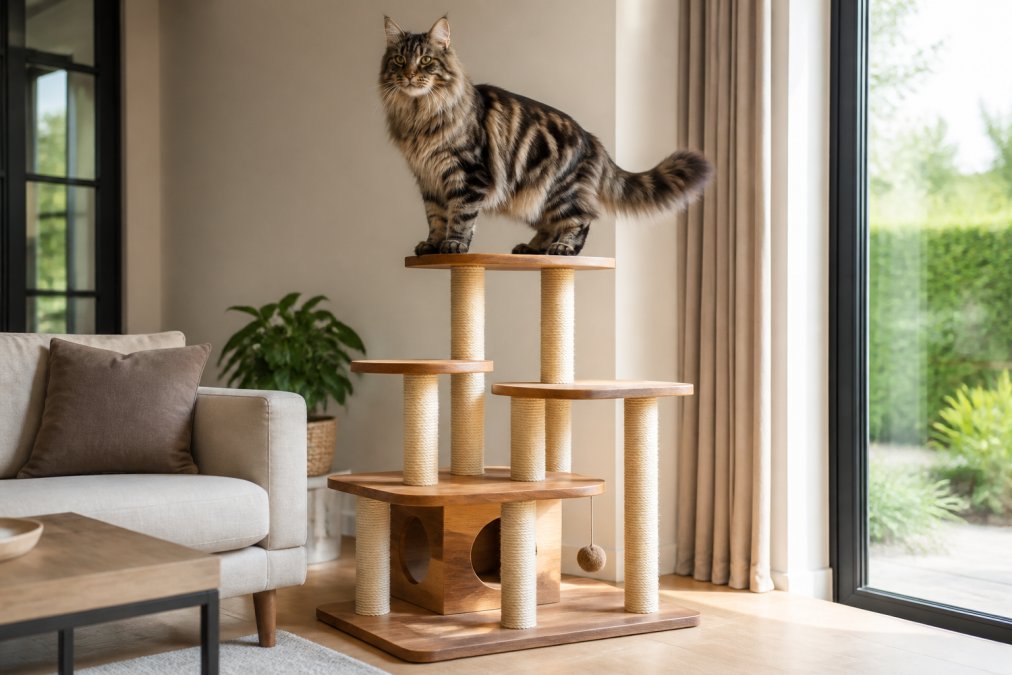
How to Secure a Cat Tree to the Wall (Step by Step)
Securing a cat tree to the wall takes about fifteen minutes with a strap or L-bracket, a stud finder, and two screws long enough to reach framing. Anchoring is the difference between a tree that survives a large cat and one that tips.
Total Time: 15-20 minutes Difficulty: Beginner
What You'll Need
- Wall anchor strap or L-bracket (many trees include one)
- Stud finder
- Drill and driver bits
- Two wood screws long enough to bite into a stud
- Level
- Position the tree. Place it where you want it permanently, ideally against a wall or in a corner, and confirm it sits level.
- Locate a stud. Run the stud finder along the wall at the strap's attachment height and mark the stud centers.
- Attach the strap to the tree. Fix the wall-side end of the strap or bracket to the upper frame using the supplied hardware.
- Drill and drive. Drill pilot holes into the marked stud, then drive the screws through the bracket into the framing. Never anchor into drywall alone.
- Check the tension. The strap should be snug with minimal slack. Press firmly on the top platform; the tree should not move more than a fraction of an inch.
Oversized Perches, Reinforced Posts, and Space-Saving Designs
Oversized perches and reinforced sisal rope posts matter more for large cats than extra height, and space-saving vertical designs let a big tree fit a small room without sacrificing platform size. Floor-to-ceiling tension poles are the classic option, using the ceiling as an anchor instead of a wall.
For tight apartments, look for:
- Floor-to-ceiling tension poles that need no wall drilling
- Corner configurations that use dead space
- Wall-mounted platforms that free up floor area entirely
- Modular cat condos you can expand as your household grows
Replacement Parts, Assembly, and Long-Term Care
Replacement parts availability is the most overlooked factor in cat tree longevity, and the difference between a piece of furniture and a disposable purchase. A tree with a worn sisal post and frayed platform cover is salvageable if you can buy those components separately, and landfill-bound if you cannot.
The Serviceability Checklist
Before purchasing, confirm the manufacturer sells these four items individually. If any is missing, treat the tree as a single-use product and price it accordingly.
- Sisal post sections, the most common wear item. Confirm the replacement matches the original diameter and mounting pattern.
- Perch and platform covers, covers wear through at the edges where cats launch. Removable, washable covers roughly double a platform's usable life.
- Hardware kits, bolts, threaded rods, and wall-anchor straps. Bolts are the failure point, so a tree with no replacement hardware has a hard expiration date.
- Base weight or ballast, some designs accept sand or water ballast in a base cavity. Confirm fill type and capacity so you can re-tune stability as the household changes.
Cost Per Year of Ownership
A cheap tree that lasts two years and a premium tree that lasts ten can share a sticker price and have wildly different real costs. Run the math:
- Divide purchase price by expected service life for a baseline annual cost.
- Add one sisal post replacement and one cover replacement per year of expected life.
- Subtract resale or hand-me-down value if the tree is modular.
Assembly as a Maintenance Checkpoint
Treat assembly as the first maintenance event. Tighten every bolt at the end of assembly, write the date on tape under the base, and re-check on a schedule. Fasteners settle most in the first three months, so monthly checks catch problems before they become wobble.
A Care Routine That Extends Lifespan
- Vacuum upholstery weekly to stop grit grinding into the fabric
- Re-tighten all bolts monthly for the first three months, then quarterly
- Inspect sisal rope for fraying and loose wraps each month
- Check the wall anchor tension quarterly
- Replace worn post sections before the core is exposed
- Rotate the tree 180 degrees every six months so wear is distributed across posts and platforms
- Spot-clean covers with a pet-safe enzyme cleaner rather than machine washing, which shrinks most covers
Age-Specific Considerations for Large Cats
A tree that works for a two-year-old Maine Coon may not work for the same cat at twelve. Senior large cats often develop joint stiffness, and a high platform they once launched onto becomes one they avoid. Two adjustments extend the tree's usefulness:
- Add a ramp or a stepped intermediate platform so the cat can climb rather than jump to the top perch. Many modular trees accept an add-on ramp section.
- Lower the highest perch by reconfiguring platforms, or add a thick orthopedic pad to the top platform to cushion landings.
Conclusion
Choosing furniture for a large cat is an engineering decision as much as a style one, and getting it wrong means a tipping tower and a nervous cat. Pet and Home Outlet carries many home and pet categories with quality in every order, so you can match a sturdy tree to your space without bouncing between stores. Browse the selection, compare base dimensions and frame materials side by side, and check out confident you are buying furniture built to hold its ground.
Frequently Asked Questions
What is the best cat tree for large, heavy cats?
The best cat tree for a large cat has a wide, weighted base, solid wood framing, and posts reinforced with sisal rope. Look for perches at least 18 to 24 inches wide so your cat can stretch out fully. A cat tree weight capacity of 30 pounds or more per platform handles most large breeds. Wall anchoring hardware adds an extra layer of safety for rambunctious climbers.
Do large cats need wider perches on their cat trees?
Yes. Large breeds like Maine Coons and Ragdolls need perches at least 18 inches wide, and 24 inches is better for full lounging. Narrow perches force cats to hang over the edge, which they avoid. Measure your cat nose to tail base and pick perches that match that length. Oversized perches also reduce the chance of a cat slipping off mid-nap.
How do I stop my cat tree from wobbling when my cat jumps on it?
Start with a cat tree that has a wide, heavy base, ideally 24 inches square or larger. Place it on a level floor and tighten all bolts after assembly. If it still sways, use wall anchoring straps or L-brackets to secure the top to a wall stud. Adding weight to the base, such as a sandbag inside the bottom platform, also reduces movement during climbing.
Are wooden cat trees better for large cats than particle board ones?
Solid wood cat trees hold up far better under heavy cats. Particle board can sag, crack, or strip at screw points within months when a 15-pound cat launches onto a perch. Solid wood frames resist that stress and last years. If you want durable cat trees for large cats, check the frame material and the base before anything else.