
Table of Contents
- Why Pet-Friendly Rugs That Don't Trap Hair Matter
- Best Rug Materials for Dog Hair and Pet Shedding
- Low Pile vs. High Pile Rugs for Pets
- Key Features That Stop Hair Trapping
- How to Clean Pet Hair From Rugs Effectively
- Durability, Claw Resistance, and High-Traffic Performance
- Common Mistakes Pet Owners Make When Choosing Rugs
- Frequently Asked Questions
Last Updated: October 4, 2026
Why Pet-Friendly Rugs That Don't Trap Hair Matter
Pet ownership brings joy, companionship, and one persistent challenge: managing shed hair everywhere. Pet friendly rugs that don't trap hair are designed specifically to solve this problem while maintaining durability and aesthetic appeal in your home.
The right rug saves hours of cleaning time weekly. Choosing a surface that resists hair entanglement protects your floors, reduces allergens from accumulated dander, and extends the rug's lifespan.
The difference comes down to understanding which materials, weaves, and backing systems actually prevent hair from embedding into fibers.
Best Rug Materials for Dog Hair and Pet Shedding
Not all rug materials perform equally when it comes to trapping pet hair. The fiber type determines how easily hair releases during vacuuming and whether it becomes matted or knotted into the pile.
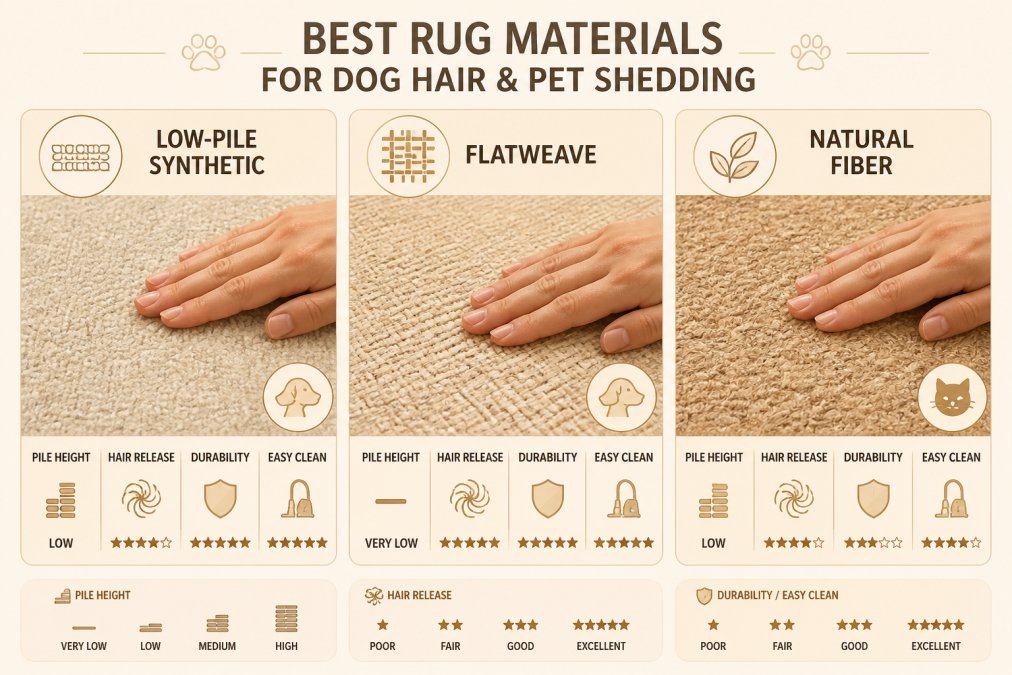
Synthetic Fibers vs. Natural Fibers
Synthetic fibers like polypropylene and polyester outperform natural fibers, they have smooth surfaces that resist hair entanglement and are inherently stain-resistant and moisture-wicking.
Natural fibers such as wool, jute, and sisal absorb moisture and trap hair more easily, making them unsuitable for pet homes.
For households with dogs or cats, synthetic fibers are the practical choice, they clean faster, maintain appearance longer, and cost less to replace.
Low Pile vs. High Pile Rugs for Pets
Pile height directly affects hair trapping. Low-pile rugs have fibers standing ¼ to ½ inch tall; high-pile rugs exceed 1 inch.
Hair slides off low-pile surfaces during vacuuming because it has no room to sink and tangle. One vacuum pass over low-pile leaves it noticeably cleaner than multiple passes over high-pile.
Low-pile also resists matting from foot traffic and pet paws, while high-pile flattens under pressure, creating visible wear patterns.
For any home with shedding pets, low-pile is non-negotiable. The cleaning difference alone justifies the choice, regardless of other factors.
Key Features That Stop Hair Trapping
Three specific features determine whether a rug actually performs as advertised for pet owners.
Flatweave, Loop Pile, and Weave-Type Mechanics
Not all low-pile constructions perform identically. The weave structure itself determines how hair interacts with fibers and whether claws snag or slide across the surface.
Flatweave rugs have fibers woven horizontally and vertically in a single plane with no pile standing above the base, making them the gold standard for hair management, a single vacuum pass removes nearly all loose hair.
Loop pile (also called Berber) features looped but uncut fibers that resist matting better than cut pile. Tight loop construction, densely packed loops, performs significantly better than loose loop for pet homes.
Cut pile (standard plush or saxony) has fibers cut at the top, leaving open ends where hair wraps and tangles, the worst choice for shedding pets.
Fiber density matters equally to weave type. Tightly woven fibers (typically 40+ oz per square yard for pet rugs) leave minimal gaps where hair can slip through.
Claw resistance: Cats snag on cut-pile fibers; loop pile resists better. Polypropylene resists snagging from both cat and dog claws better than natural fibers because it doesn't fray or pull apart as easily.
Non-Slip Backing, Rug Pads, and Moisture Management
A quality rug pad prevents shifting and creates a critical barrier against moisture buildup, a function most pet owners overlook until odors develop.
When pets have accidents, urine soaks through the rug pile and backing. Without a rug pad, liquid contacts the floor directly, creating mold and bacterial growth underneath. A quality rug pad with moisture-wicking properties allows air circulation underneath, preventing this sealed, damp environment.
Non-slip backing adds grip, but confirm compatibility with standard rug pads before purchase, rugs designed for pet homes should accept pads without issue.
Rug pads distribute weight evenly, reducing wear patterns from repeated pet traffic and extending the rug's lifespan.
For households with pets prone to accidents, a rug pad with superior moisture-wicking is as important as the rug itself, preventing the moisture trap that causes lingering odor.
Stain Resistance and Moisture-Wicking in Fiber and Treatment
Accidents happen. Stain-resistant treatments prevent liquids from setting into fibers, while moisture-wicking moves liquid away from the surface so it can be blotted up before it soaks through.
Synthetic fibers naturally resist staining better than natural ones. Polypropylene and polyester don't absorb liquid the way wool does. Additional stain treatments, typically applied during manufacturing, add another protective layer. Look for rugs treated with fluorocarbon-based or other pet-safe stain treatments that repel both water and oil-based accidents.
Moisture-wicking becomes critical in homes where pets occasionally have accidents. A rug that wicks moisture away from the surface prevents odors from developing deep in the pile and reduces the time liquid sits on the surface before it can be cleaned. This feature alone can determine whether a rug remains fresh-smelling or develops persistent pet odors over time. Paired with a moisture-wicking rug pad underneath, this creates a complete moisture-management system that handles accidents before they become permanent problems.
How to Clean Pet Hair From Rugs Effectively
The best rug is only as good as your cleaning routine. Proper technique removes hair before it embeds deeper into fibers, but for pet owners with allergies, cleaning also addresses dander accumulation, a major allergen source that hair removal alone doesn't solve.
Vacuuming Technique and Frequency for Hair and Dander Removal
Vacuuming removes loose hair, but dander, the microscopic skin flakes pets shed, requires different handling. Pet dander is a primary allergen for people with pet sensitivities, and it accumulates in rug fibers even when visible hair is removed.
For homes with shedding pets, vacuum at least twice weekly, more frequently in high-traffic areas. Each pass should be slow and deliberate, allowing the vacuum to extract hair fully rather than pushing it deeper.
Use a vacuum with a HEPA filter, these capture particles as small as 0.3 microns, including pet dander. Standard vacuums without HEPA filtration recirculate fine particles back into the air, defeating the purpose of cleaning for allergy management. HEPA-filter vacuums make a measurable difference in air quality for households with pet allergies.
For flatweave and low-pile rugs, upright or canister vacuums work well. For loop pile, use a vacuum without a beater bar, which can damage the loops; a suction-only model or a vacuum with an adjustable beater bar set to the correct height prevents this damage while still removing hair effectively.
Spot Cleaning, Deep Cleaning, and Allergen Management
Spot cleaning handles fresh spills and accidents immediately. Blot liquids with a clean cloth, do not rub, which pushes liquid deeper into fibers and backing. For solids, remove what you can by hand, then vacuum the area thoroughly.
For allergen management, regular spot cleaning of high-traffic areas where pets rest (beds, favorite napping spots) reduces dander concentration. Enzyme-based pet stain removers break down the organic compounds in urine and feces, eliminating odor sources rather than just masking smells. These products also help remove dander-laden residue from accidents.
Deep cleaning every 6-12 months removes embedded allergens that regular vacuuming misses. Professional hot-water extraction (steam cleaning) is most effective for allergen removal, as the heat and moisture lift dander and hair from deep within the pile. For machine-washable rugs, washing in hot water with a pet-safe detergent achieves similar results. Check the manufacturer's care instructions before purchase; machine-washable rugs typically have synthetic backing that survives the wash cycle.
For rugs that aren't fully washable, professional cleaning services handle deep cleaning and allergen extraction. This extends the rug's life and removes accumulated dander that contributes to indoor allergen levels.
Odor Neutralization and Allergen-Reducing Maintenance
Pet odors come from bacteria in urine and feces, not the accidents themselves. Enzymatic cleaners break down these organic compounds rather than just masking the smell. For fresh accidents, enzymatic treatment prevents odors from setting permanently.
Baking soda sprinkled on the rug and vacuumed up after 15-30 minutes absorbs odors naturally and works well for maintenance between deeper cleanings. This method also helps reduce airborne dander by capturing some particles before they circulate. For households with pet allergies, this simple step provides noticeable relief.
For persistent odors, enzymatic treatments designed specifically for pet urine are more effective than general odor eliminators. These products use live bacteria or enzymes to consume the organic compounds causing the smell, eliminating the source rather than covering it.
Choosing Rugs and Materials for Allergy Management
Beyond cleaning technique, material choice affects allergen accumulation. Synthetic fibers like polypropylene trap less dander than natural fibers because they don't absorb moisture and skin oils the way wool does. Dander adheres less readily to smooth synthetic surfaces, making it easier to remove during vacuuming.
Flatweave and low-pile construction also reduce allergen trapping compared to high-pile alternatives. The minimal fiber depth leaves fewer places for dander to settle and accumulate. Combined with regular HEPA vacuuming, low-pile synthetic rugs significantly reduce airborne allergen levels in homes with shedding pets.
For pet owners with moderate to severe allergies, selecting a low-pile, densely woven synthetic rug paired with consistent HEPA vacuuming and professional deep cleaning twice yearly creates an allergen-management system that makes pet ownership more comfortable.
Durability, Claw Resistance, and High-Traffic Performance
Pets damage rugs through scratching, paw traffic, and accidents. Understanding durability helps you choose a rug that survives years of use.
Claw resistance depends on fiber construction and density. Tightly woven synthetic fibers resist snagging from claws better than loosely woven or natural fiber rugs. Polypropylene specifically resists damage from scratching because the fibers don't easily fray or pull apart.
High-traffic areas show wear faster. Pets tend to use the same routes repeatedly, creating visible matting or color fading in those zones. Choosing a rug with excellent fiber density and a durable backing system slows this process.
Pet-friendly rugs should carry durability ratings indicating suitability for high-traffic use. These ratings tell you how many foot-traffic events the rug can handle before visible wear appears. Ratings designed for "heavy traffic" or "commercial use" hold up better in homes with active pets.
Common Mistakes Pet Owners Make When Choosing Rugs
Most pet owners focus on color and style first, then discover cleaning challenges afterward. This backwards approach leads to frustration.
The biggest mistake is choosing high-pile because it looks luxurious. High-pile feels soft underfoot but becomes a nightmare with shedding pets. Hair embeds within days, and vacuuming never fully removes it.
Another common error is buying natural fiber rugs for their aesthetic appeal without considering maintenance reality. Wool and sisal look beautiful in showrooms but trap pet hair aggressively. The cleaning effort required often outweighs the visual benefit.
Ignoring stain resistance is a third major mistake. Pet owners assume accidents won't happen, then panic when they do. Choosing a rug without stain treatment means permanent stains from the first incident.
Finally, many people overlook the importance of rug pads. A rug that slides creates safety hazards and wears unevenly. Quality pads cost far less than replacing a damaged rug.
Choosing the right rug transforms pet ownership from a constant cleaning battle into a manageable routine. Look for low-pile, densely woven synthetic construction with stain-resistant treatment and non-slip backing. These features address the real challenges pet owners face daily.
Frequently Asked Questions
What rug material is best for dog hair?
Synthetic fibers like polypropylene and nylon resist pet hair trapping better than natural fibers. Low-pile and flatweave constructions are ideal because hair sits on top rather than sinking into dense fibers. Look for stain-resistant, washable options with tight fiber density to minimize shedding and make vacuuming easier.
Are high-pile rugs bad for pets?
High-pile rugs trap pet hair, dander, and odors deep within the fibers, making them difficult to clean and maintain. They're also prone to snagging from claws. Low-pile alternatives offer better durability against scratching and require less frequent deep cleaning while keeping your home healthier for pets and people with allergies.
How do you get dog hair out of a rug that traps it?
Vacuum frequently with a pet-hair-specific vacuum that has strong suction. For trapped hair, use a rubber broom or pet hair removal tool before vacuuming. Spot-clean with a damp cloth, and consider machine-washable rugs for deeper cleaning. Regular maintenance prevents hair from embedding permanently into the fibers.
Are washable rugs better for pet owners?
Machine-washable rugs are excellent for pet owners because they handle accidents, spills, and odors more easily than traditional rugs. They reduce the need for professional cleaning and allow you to maintain hygiene without harsh chemicals. Ensure the rug has a non-slip backing and is sized appropriately for your space to prevent shifting during washing.